

Since the early 2000s, social media platforms have existed. They’ve evolved dramatically during this time. They started off as something to simply help individuals connect with their family, friends, colleagues, or just other like-minded individuals over the internet.
Soon businesses made a foray onto these platforms, seeing the opportunity to expand their fan and user bases. The platforms therein saw monetization potential and today social media marketing has morphed into a multi-million dollar industry.
Nowadays, social media plays an important role in marketing. So naturally, you would think that marketers will know what social media marketing or SMM is. The problem is that most just know the definition very well. They overlook an important aspect of how to use it.
Social Media Marketing Misunderstood
Just try googling “what is social media marketing”. You will see numerous definitions, but almost all will be along the lines of –
Creating content for the various social media platforms to connect with your audience, promote your brand, and sell your products and services by driving user engagement.
While this is not technically wrong, I feel there is one major aspect that is missing from this definition.
It is like when someone asks you to define Tennis and you tell them that it’s a racket sport played by two individuals or two teams of two players in which the players strike the ball over the net to score points. Again, while the definition is right, it doesn’t mention winning the game, set, match, championship, or attempting to achieve the top rank.
The Evolution Of SMM
Definitions help you to understand the what. When you concentrate solely on the what, you tend to overlook the why. Let me get this straight, I don’t want to propose a new definition for social media marketing. I just want to point out that focusing on only the what may not yield the desired results.
So, how does this apply to social media marketing? Just doing what the definition suggests will get you some results. However, it doesn’t help you tap into the full potential of this medium. Among all the marketing channels, social media is most likely the most distinctive. Unlike other mediums, this is one where it’s not just you who gets to share your own story.
The reason is the fact that social media marketing and marketing, in general, has moved away from the marketers and into the hands of the consumers. Mark Schaefer has covered this aspect wonderfully in his book, Marketing Rebellion.
When people are looking for information about brands, they aren’t looking for the brand’s advertisements, social campaigns, or press releases. They get their information from other consumers on social media, user reviews, and user-generated content. Essentially, as a brand, you may no longer completely own your story.
How To Approach Social Media Marketing
This is where the potential of social media marketing is so frequently overlooked. It is widely treated as yet another marketing channel in which tactics and messages from other channels are repurposed. It becomes easy to neglect the social aspect of social media, the very reason these platforms were conceived in the first place.
The power of social media is in the personal connections you can make with the end-user and join in conversations with them. Basically, you need to treat social media very differently from the other marketing channels.
The ultimate business outcome defines your activities and approach on all other channels. For social media, on the other hand, you need to ask yourself what your audience wants to hear from you, not what you want to tell your audience. Basically, you need to put your audiences’ interests right at the center. The outcomes that you desire, such as increased website traffic and higher rates of engagement, will be the fallout of this action.
If the core of your social strategy involves building relations with your audience, being human with them, and basically bringing back the social in social media you will be doing social right!
There are many elements in social media marketing. So it is essential to pay attention to all these elements to get your overall strategy right. They can be broken down into seven aspects, which I’ve highlighted here
The Seven Fundamental Elements Of SMM
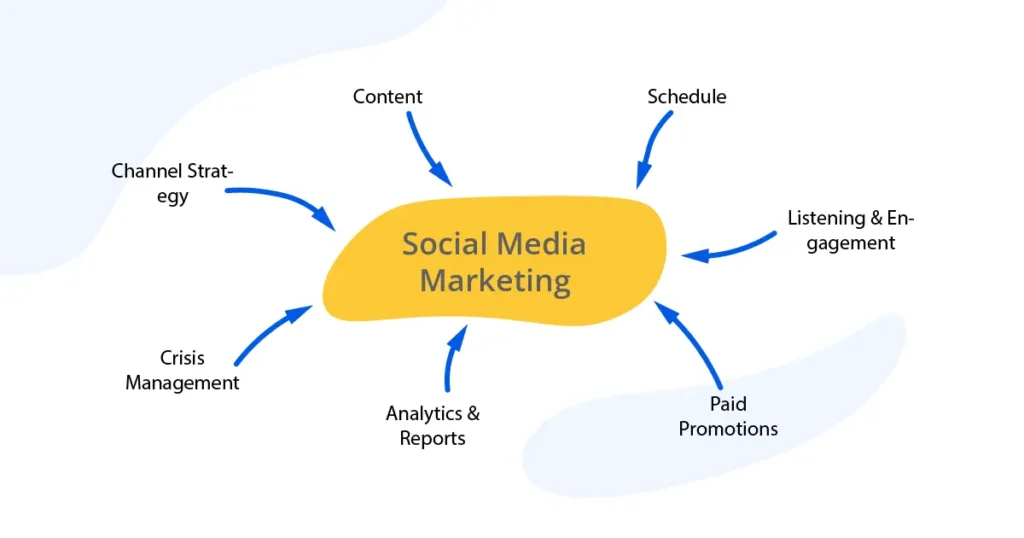
Channel Strategy
The channel strategy will define who you want to reach out to, how you want to approach them, and what you want to achieve through your activities. This will also determine which channels you will use.
There is a common misconception among many marketers when it comes to brand presence on all social channels. There is a strong urge to be present on every channel available, and sometimes on a new channel as soon as it crops up. Often the argument is that there is not much effort involved as one can basically replicate the posts from one channel to the other, tweaking it slightly to cater to the intricacies of the new channel.
Each channel is distinct, and the audience behaves and expects differently from each. Assume you are sitting next to your friend and wish to have a conversation about something. The tone, the duration, the sentences used, and the manner of communication will differ based on whether you are sitting in a park, in your living room, at a concert, or at a funeral.
Social channels are something similar in nature. Despite the fact that you want to convey the same message, there will be significant differences depending on the channel you use to communicate that message.
So, before you decide to have a presence on any channel, you need to ask yourself some basic questions such as – Who is your audience? Where are they present and how can you best reach them? What are your overall goals? Does the team have the capacity to maintain a high-quality experience for the audience on every channel? What will be your brand persona? Will you humanize your brand or keep it professional?
Answers to these questions will help you define your channel strategy.
Content
Content forms the backbone, for not just a social marketing strategy, but any marketing strategy. “Content is king” is not at all new, but following this is what will help you to cut through the noise.
The content for any social media strategy should start with the story you wish to tell or the value you wish to add to your audiences’ conversations through your social presence. Consider creating a timeline for a potential end-user. Assume they know nothing about you at the outset. How would you like to take them from that to a point where they benefit from interacting with you on social media? Plan this journey for them, and you’ll have the answers for your approach.
Speaking at a more tactical level the content element would also include the type of messages you would be posting and the creatives or the multimedia assets you would be using. Furthermore, you should also look to define your content mix. The content mix is the different categories of posts you would be sharing on your timeline.
For example, as a brand looking to establish thought leadership in a specific niche, your entire social timeline can not consist of social posts driving traffic to authoritative and informative blogs. You definitely need to share some interactive multimedia content, infographics, live content, event updates, and try to interact with the audience every now and then. Settle on a mix that works best for you, and don’t be afraid to experiment and tweak it as per the changing requirements.
Schedule
After determining which channels you want to maintain a presence on and what you want to convey on these channels, the next critical step in the strategy is to develop a publishing schedule. This will cover the frequency of the posts as well as the time they are published.
The schedule will depend on a number of factors, including the intricacies of the channel, the audience behavior, and, of course, the content strategy. While there is no hard and fast rule regarding the number of posts on each channel, there are some guidelines you can follow to arrive at a number that works for you.
This is also the part where you will work on your content calendar and the social media calendar. Sometimes these two terms are used interchangeably, but depending on the organization, they can refer to two very distinct things used by different teams.
The content calendar assists the team to plan out the content strategy for a specific time period. Depending on the team’s content marketing strategy, this time period could be a week, a month, or even a quarter. A social calendar, on the other hand, addresses the day-to-day activities on each of the channels at times. It may even highlight specific key days and dates, as well as the activities that the team must plan ahead of time for these days.
As always, an organized approach here will assist you to generate content that is timely and valuable for your audience. I’ve written an article on the best time to post on social media which covers both, time and frequency. You can use to guide your research on the topic.
Listening And Engagement
This is one aspect of social media that almost everyone recognizes as important but is prioritized over some of the more pressing aspects of the role. This is partially due to the fact that the returns from this activity aren’t immediately recognizable or largely tangible in nature. However, in the long run, this is the activity that really helps bring the social aspect of social media to the forefront, as previously discussed.
All of your social activities are bound to spark some discussion. These discussions can include responses to your posts, positive feedback, negative criticism, discussion of recent news updates, and so on. Keeping track of these comments will allow you to keep your finger on the pulse of these discussions. This is referred to as listening.
Listening can be accomplished through simple techniques such as using keyword or hashtag searches, using Twitter lists or adding people to your close friends list on Instagram to track certain handles, or through more sophisticated tools such as Sprout Social, Hootsuite, or Buffer.
When you come across interesting comments while listening, the logical next step is to engage with them. Sharing, retweeting, liking, replying, and other forms of engagement are examples. This part actually lets your audience know that you are paying attention to them. The more you interact, the more trust you build with your audience. This directly contributes to the growth of your brand.
Paid Promotions
Social media was long considered the channel from which you can get returns without investing actual dollars, thanks to organic social media. However, in the long run, with a competitive landscape and changing algorithms, you can’t avoid investing in paid promotions.
However, you can benefit from the powerful targeting parameters available on social media channels. When done correctly, social media ads can enable you to speak to a wider audience beyond those who are already following you. These channels allow you to target audiences based on their demographics, interests, keyword searches, and other factors.
When you decide to get into this, there are so many options that it is easy to become overwhelmed. I’ve put together a free downloadable handbook called The Paid Social Marketing Handbook to help you get it right. It will advise you on everything you need to get started as well as the factors to consider when running a successful paid campaign.
Analytics And Reports
Along the way, you’ve done a lot of good work. Wouldn’t you like to see how it’s doing? How many positive brand mentions have you received? What was your brand’s monthly share of voice? Are you effectively tracking your brand influencers?
Most social platforms offer native analytics, which will give you insights into the basic metrics such as followers, likes, and shares among others. However, this is generally insufficient for gaining an in-depth understanding of the actual performance of your marketing efforts. What we get are primarily vanity metrics. The true insights come from your ability to analyze all of the metrics in tandem and derive related insights rather than relying on each as a stand-alone metric.
This is where social management tools come in handy. They assist you in gathering all of these insights in one place. What you can make of them is what will define your social media success.
Crisis Management
The majority of the notes or guides on social media marketing tend to exclude the crisis management aspect. A real crisis of a certain magnitude is so uncommon that is easy to dismiss the importance of being prepared. But when it all goes wrong, you’ll wish you had a solid plan in place. A public relations crisis can explode on social media in the blink of an eye and seemingly out of nowhere. It is best to be prepared ahead of time.
As a result, every organization’s social media strategy should include a crisis management plan. It should include the key personnel who will be a part of the crisis response team, a plan of action, and a stand-by statement. Having all of this in place will help you better plan and be on the lookout for potential issues that have the capacity to explode into a full-fledged crisis.
Bring Back The Social In Marketing
Social media is ever-evolving. Strategies, approaches, personnel, and budgets will all also need to evolve as a result. What will not change is the people you will reach out to and interact with. Putting them first will ensure that, no matter what happens in the world around you, you will always have the ears of your world open for you.
What is your take on the evolution of social media marketing over the years? Where do you see it going in the future? Drop your thoughts in the comments section.
