
There are two most commonly asked questions about social media that are closely related. How often do I post on each platform? What is the right time to post on each platform? If you’ve yourself asked this question and are incredibly curious to know the answer then you are in for a surprise.
The myth buster is this – There is no precise answer to either of these two questions.
To some, this may be a little shocking, to say the least. The others may scoff and dismiss this statement in derision. There has to be a good and a bad time to post, right? The answer is a resounding NO!
But there are certain key pointers for you to consider to ensure that your content reaches a wider audience. In this article, I’ll explain why there are no right answers to the questions above and share recommendations for what will work for you.
Statistical Best Time To Post: Why It Doesn’t Work
I’ve read numerous articles stating the right time to post on different platforms and the optimal frequency. This is typically supported by the research of over 10,000 or 500,000 posts from various brands across various industries.
First and foremost, I don’t want to discount these individuals’ or entities’ efforts or the research itself. But the caveat here is that what works for them need not necessarily work for you.
If you ask any social media manager, they will almost certainly tell you that their brand belongs to a specific industry, but it is unique in its own way.
The brand may be using a different set of tools that optimize different aspects of social publishing in comparison to its competitors. Brand loyalty varies, and the quality of posts will almost certainly vary as well. Brands operate in various time zones and serve audiences both locally and globally. Most importantly, the maturity of the marketing team of each brand will vary and so will the capacity of the social team.
If every factor that influences a social media post is unique to each brand, how can a generic report on the best times be the perfect suited for your unique brand?
To be fair, all of these articles state that the best times and frequencies are based on a large data set and may not apply to everyone. They advise you to experiment but don’t always tell you how to go about doing that. However, they are usually followed by such specific recommendations for each platform that you will undoubtedly try to implement those timings and frequencies. This can potentially leave you shortchanged.
So in this article, I’ll steer clear of mentioning frequencies or time slots that might work. Instead, I’ll tell you what actually influences the performance of the posts and how you can find the best time and day that works for you and your brand.
Factors That Determine Your Posts’ Time And Frequency
Now that we’ve established that you shouldn’t take the values in your search results as gospel, let’s look at the six factors that do matter. Evaluate each of these six to better understand the steps you need to take to find the best time and frequency for your brand.
Social Media Objectives
Before we answer the question of how much, we need to answer the question of what. What is it that you want to get out of your social media marketing efforts?
Is your goal brand recall or brand awareness? Then your objective is to ensure that your posts get high impressions.
Are you aiming for engagement? Then your objective is to get a lot of likes and shares on your posts.
Do you want people to visit your website? Then your objective is to get a high number of clicks on your posts.
So, before you look at a guide that suggests the perfect time to post for the highest reach, make sure it aligns with your social media strategy. This is due to the fact that each objective will necessitate a distinct messaging strategy. Each strategy will have a unique content calendar which will require you to cover a number of different themes to help you achieve the ultimate objective.
So, in effect, your social objectives will go a long way in dictating the number of times you post in the first place.
Audience Behaviour
Once you’ve determined your social media objectives, you need to address the next critical piece of the puzzle – the audience you wish to reach out to.
Understanding the audience’s behavior is a crucial aspect. How and when are they going to engage with your posts? Publishing around the time your target audience is most likely to engage with the posts will maximize their potential.
If your target audience is most likely to engage with your content when they are winding down for the day, it makes little sense to publish all your posts in the morning. If, on the other hand, your audience engages with your brand only during business hours, then you should try and make the most of that time.
This does not imply that you need to publish exclusively when your audience is most likely to engage with your brand. There will be plenty of reasons for you to post during the non-peak hours. This will be determined by your social media objectives and the associated content strategy, as previously discussed. But the point is that these two are essentially related. Understanding the behavior of your target audience will help you craft a more effective outreach strategy.
Social Platforms In Consideration
Another critical factor to consider is the platforms on which you intend to publish. Along with that, you must determine the platforms on which your target audience is most likely to engage with your content.
For example, if your brand relies heavily on visual content, Instagram may be your best bet. Post after post on LinkedIn may not yield the desired results. However, if key business leaders are your primary target audience for your B2B company, then LinkedIn is essential for success. Facebook may not provide you with a comparable return on investment.
No two social media platforms are alike. It will be very easy to copy and paste the same piece of text, and at times the image, across all platforms. But each of them will treat your content differently. As a result, it is always best to tailor the content to the platform.
It takes time and effort to tailor content for different platforms. So take this into consideration when you plan the optimal number of posts for each platform on which you have a presence.
Location And Time Zone
Where are you based? Where is your target audience located? Are you attempting to reach to a local audience or does your brand have a global presence?
This is one of the most important aspects that the majority of studies that present recommended times overlook. When researching a number of brands, it is not always possible to determine which time zones each caters to. Some are global, while others are regional. So adding them all together will not give you the optimum time.
Concentrate on your regions and time zones, as well as those of your target audience. Together, they will have an impact on your content strategy and the timing of your posts.
Competitor Analysis
The next factor, while not directly influencing posting frequency or timing, is one you should be aware of – your competitors.
It is obvious that you and your competition are vying for largely the same set of eyeballs on social media. As a result, you need to take into consideration their social scheduling strategy. This is not to try and mimic it or go completely contradict it. Its intention is to help you in establishing your own strategy.
If one of your competitors is a well-established brand with a large social following, they will know when their target audience is online and how to be available to them at that time. So taking a leaf out of their book for your own social media schedule may not be a bad idea. However, if your research reveals a void in their schedule, you can position yourself to capitalize on it.
Content Generation Capacity
Let’s say you come across a suggestion that says you should publish five posts on a specific platform every day. This recommendation takes neither the size of the brand nor the social team into account.
This is significant for two key reasons. The larger the brand, the more content you have to share with your audience in the form of blogs, infographics, videos, and so on. In addition, more heads are likely to be involved in putting everything together.
Smaller brands, on the other hand, have smaller teams or even individuals who work on everything. This person will be in charge of content creation, creatives, publishing, and analytics. They may also not have as many new and interesting things to share with their audience as frequently as larger brands. Five posts in such a scenario could become overwhelming for an individual, and bear in mind, this is just one platform.
So it is not the ideal number that you should strive for that is important. You should also think about how much you can potentially publish based on the size of your team and the number of content pieces you can share with your audience.
How To Find The Best Time And Frequency For Your Own Social Media Accounts
We have seen some of the factors that influence your ideal time and frequency. So, if you need a starting point, let’s see how you can arrive at an ideal number that works best for you.
Existing Data Analysis
The easiest way you can get a good idea of your approach is through your own data. As a first step, you’ll need to find a way to export all your social posts for a specific time period.
This time frame may differ from platform to platform and brand to brand. It is obviously beneficial to have as much data as possible for analysis, such as a year’s worth. However, you can get started with as little as three months of data.
This data is easily accessible via the analytics tab on LinkedIn, Twitter, and Facebook. If you use social media management tools, then this data is available on the tool itself. You will need the time and date you published the posts, the URL, and reaction or engagement metrics such as impressions, reach, likes, shares, retweets, link clicks, and so on.
Once you export the data, filter out exceptions and outliers. This means that you’ll have to sift through the data set and remove posts that may have gone relatively viral, compared to your other posts. You will also have to exclude deleted posts and replies.
The latter is fairly obvious. You are not particularly concerned about the reach and engagement of the reply meant for a single person and deleted posts don’t count. However, why should you get rid of the best best-performing post? The pinnacle of all your recent efforts? These are possibly the questions that are popping into your mind right now.
The truth is, not all posts go viral, and including them in your analysis may result in the data getting a bit skewed. So, these steps are critical to preserving the dataset’s integrity and obtaining a more accurate analysis.
Once you do this, you can plot the data of time vs engagement metric to get a sense of what works best for you. Here are some examples of charts you can make with this data.
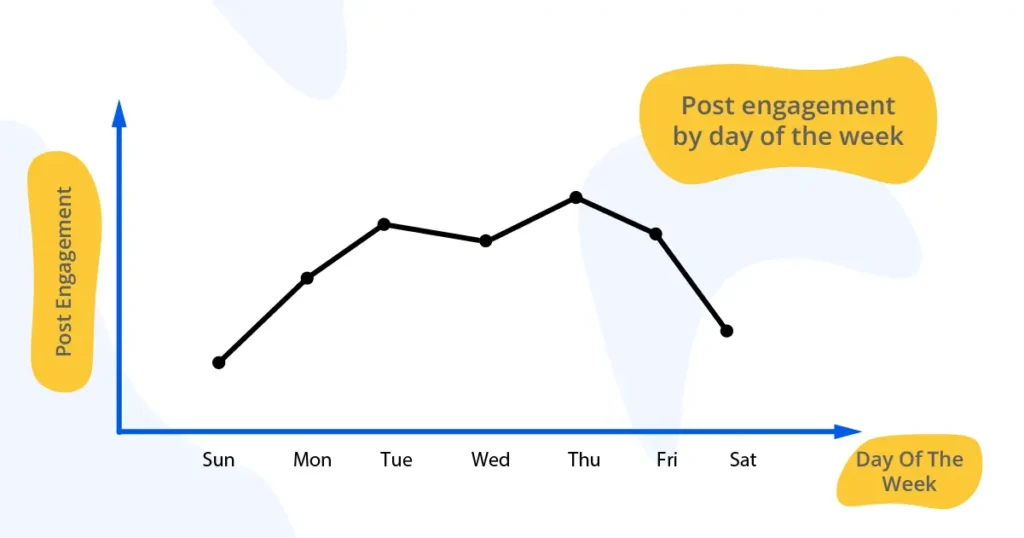
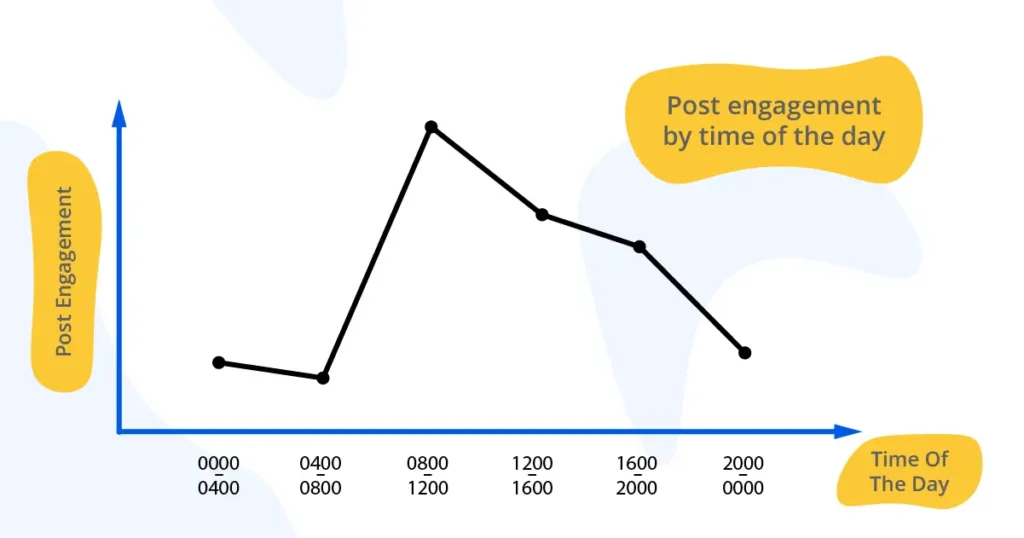
Creating charts such as these can then help guide your decision-making process.
Analyzing Website Traffic On Google Analytics
Now that we’ve seen how to analyze social behavior at its origin, let’s move on to the destination. If website traffic is vital, which it almost always is, then you must definitely take the website data into account. On Google Analytics, you can view this data in two ways.
Under the acquisition reports, you can view the Social reports. This section provides a wealth of useful information, such as the network that referred your visitors, the pages they landed on, and conversions among other things.
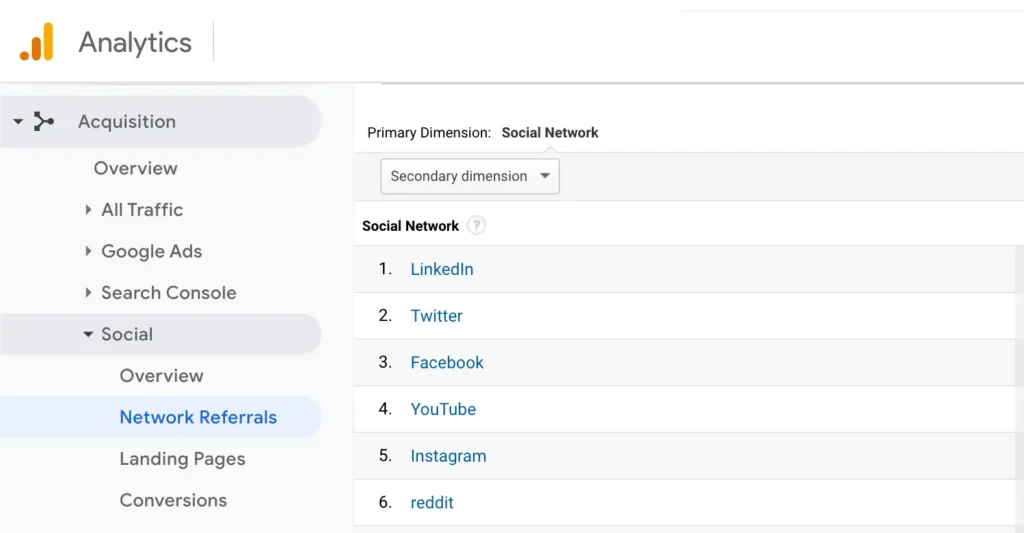
For this exercise, we are going to focus on the Network Referrals report. Here you can add secondary dimensions such as the day of the week, the month of the year, and the hour of the day. You can also examine the data at a high level, such as the week of the month, or at a granular level, such as the minutes.
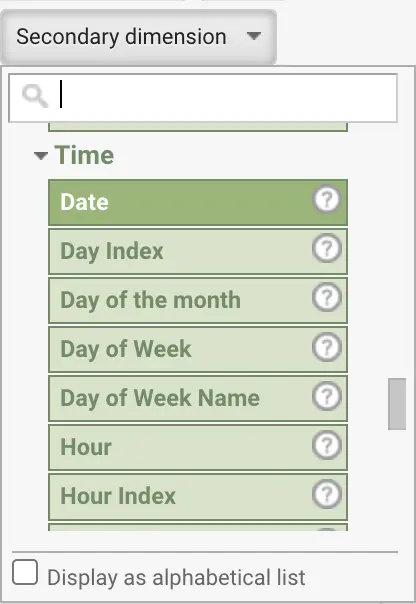
The second way is to look at the Social traffic under the Channels report. It can be found by going to the Acquisition report and selecting the All Traffic option. This is for more advanced analytics users who can make more sense of the additional data dimensions available in this report.

If you have conversions enabled in your Google Analytics instance, you can also focus your analysis on a specific type of conversion. Even with this report, the concept remains the same, you can add the secondary Time dimensions for additional insights.
Using these data points, you will be able to determine which platforms are driving traffic to your website, as well as when and on which days. So concentrating on these days and times will get you off to a good start. Regularly analyzing the data in this manner will help you stay on top of the game.
What Should You Do If You Don’t Have Historical Data?
Say you are just starting out or you are trying to resurrect dormant channels. This means that you are not going to have any data on hand to analyze.
In such a scenario, I would suggest that you first focus on the six key factors influencing your times and frequencies. You can also use some of the suggested times as a guide and start collecting your own data for analysis.
Strategies To Improve Social Media Engagement
We’ve seen some of the factors which can influence your posting frequencies. But if the post frequency is a little too much for you, then don’t worry. There are certain aspects that matter a little more than the time, day, or the number of times you post.
In other words, you can post at the absolute right time, on the right day but it won’t matter if you don’t pay attention to the following factors. These factors will ensure that you can meet your social objectives even if the timing is a little off.
Quality Is A Must, Quantity Is A Bonus
Let’s say you set a goal of publishing ten posts per day and you manage to meet it. However, in order to make up the numbers, some of these posts are just fillers or may not be your best work. In this case, you may have done more harm than good.
If your audience takes the time to interact with your post, it is imperative that they receive value in exchange. Cutting corners to meet targets can put off the audience, and some of them may not return.
So, if you can only publish one post a day, make it as useful as possible to your audience. Similarly, every post you publish should strive to meet that standard. And if you can back up this quality with enough quantity, you have a winning combination.
Frequency Is Overrated, Consistency Is Key
Now that we’ve established that quantity is more important than quality, let’s expand on the quantity point. If you are looking to build a serious following for your social accounts then the audience needs to know when they can expect fresh posts on your page.
So once you’ve determined the ideal number that works for you, make sure that you stick to that number consistently.
Assume you decide to publish twice a day, in the morning and evening, on a specific platform during the week. Then your audience will understand that they can visit your page on any day of the week and engage with two new quality posts. This will aid in the development of a devoted following on that platform.
Don’t Just Talk, Learn To Listen, Engage
The power of social media marketing is in its social aspect, which is frequently overlooked. If social media has enabled people to have direct conversations with brands and celebrities, the inverse is also true. You, as a brand, can have a direct connection with your audience, your subscribers, and your customers.
Consistently publishing high-quality content is essential. But along with that, you must also connect with the end user. As a part of your content creation strategy or publishing schedule, allocate time and effort to acknowledge audience feedback. Brand listening is an essential component of any successful social media strategy.
Join the discussions, reply to those customer service queries, add value to conversations and see the followership grow over time.
Final Thoughts
We’ve seen everything that can influence your social post frequencies and times, as well as what you can do to influence them. To be honest, there are far too many, so definitely one size does not fit all. Instead of following generic advice, investigate, strategize, and forge your own path.
Do you have any other considerations? How do you approach this problem differently? Do let me know in the comments section below.