Nowadays everyone knows what hashtags are. But does that imply everyone uses it properly and effectively on social media? When used correctly, they have the potential to be a game-changer for you. However, if you use too many and incorrectly, your social posts may be completely ignored as they appear too spammy.
Nowadays, almost every social media post includes a hashtag. Hashtags have become so commonplace that you also find them entering everyday conversations. So that brings us to the question – what is the proper way to use hashtags?
The Different Types Of Social Media Hashtags
So, to begin, why don’t you open your Instagram feed and scroll through a few posts? There will almost certainly be multiple hashtags in some of the posts you see on your feed. But are all hashtags used with the same intent?
Individuals and brands use hashtags in a variety of ways. So, before we can learn how to use hashtags correctly, we must first understand the various types of hashtags. They primarily fall into seven categories, which I’ve highlighted here.
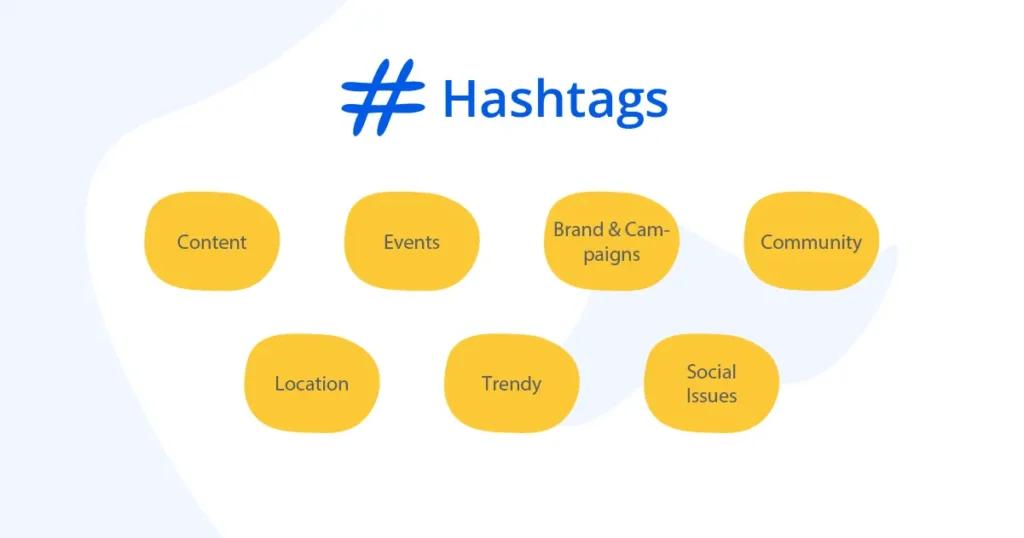
Content
This category contains the vast majority of hashtags on the internet. Are you interested in tweeting about the latest episode of your favorite show or a movie? Perhaps you’d like to catch up on the most recent discussions about artificial intelligence. Or maybe you want to highlight the fact that you are a blogger or a photographer.
In all these cases, there is an overarching content hashtag used to group your content. It facilitates the connection of like-minded users around a specific topic. Some examples are #Marvel, #Wimbledon, and #AI among others. These would also include niche hashtags such as #TravelBlogger, #WeddingPhotographer, #SocialMedia, and so on.
Events
Have you followed the Academy Awards on Twitter? You would’ve come across Ellen DeGeneres’s famous selfie by following #oscars. Perhaps you are someone who likes to participate in the live updates during the latest round of the Premier League matches using #epl.

These are examples of event hashtags. These allow you to be a part of a live conversation with others on the internet during an ongoing spectacle or an important event, such as #Elections.
This category includes seasonal and celebration hashtags such as #Christmas and #IndependenceDay. Brands that host events such as conferences or breakfast meetings also use branded event hashtags.
Brand And Campaigns
This is self-explanatory. Almost all brands use branded hashtags, such as #Nike, #Amazon, #Accenture, and so on. Consumers also use these branded hashtags to talk about brands they like, don’t like, and for customer service issues.
Brands also run various marketing campaigns, both online and offline, which they like to distinguish using unique hashtags. This allows them to organize their messages around a campaign while also encouraging the audience to participate in conversations with them.
Community
Ever joined a tweet chat? Are you part of a fan club? If you do any of these online, you are making use of community hashtags. These enable you to be a part of an online tribe, which is a group of individuals with a common purpose or interest.
You can be a group of runners who encourage one another or families who enjoy long road trips and share their experiences and tips. These hashtags are great for bringing people together for a local event, an online event, or simply asking for assistance from the helpful community.
Location
These, as the name implies, help locate you or your post. These are most commonly used on Instagram to surface local content, but they can also be used on other platforms to highlight specific regional content. These are especially popular with local businesses and tourists. Some examples are #Europe, #India, and #NYC.
Trendy
These are the ubiquitous hashtags that can be found on all platforms. These pop up on particular days or highlight a specific theme. #TBT, #MondayMotivation, #FF, and #Caturday are a few examples.
Social Issues
There was a time when we could have easily merged this with the content category. However, there has been a surge in the use of social media for social issues, warranting its own category.
With social media transcending international borders, social and political movements happening across the globe can easily become local movements. The Charlie Hebdo shooting and the tragic death of George Floyd are both examples of how international support can be gathered through social media with the use of the hashtags #jesuischarlie and #BlackLivesMatter respectively.
Nowadays, brands are getting involved in these movements and take up a stance. This can have a significant impact on society and even have an impact on the brand itself. As a result, it is pertinent to examine this category separately.
Research Hashtags Before Using Them
Now that we have learned the different types of hashtags available we need to know which ones to use and where. Along with the popularity of the hashtag, it is very important to check the relevance as well.
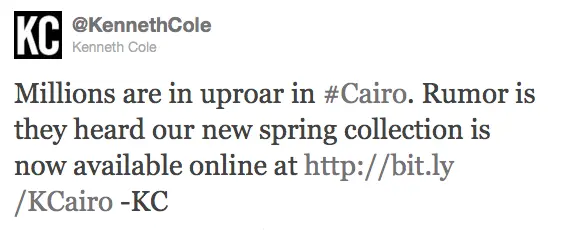
You don’t want to join a conversation promoting your spring collection when most of the posts in that conversation are around a protest, do you? That’s exactly what Kenneth Cole did in 2011 when they decided to jump in on the tweets about Egypt’s uprising with a major faux pas.
So look before you leap.
Let us first discuss the popularity of the hashtag. Yes, you want to use the most popular hashtags so that your content can be found by a lot of people. But isn’t it possible that your post gets lost in the shuffle and receives little attention? So, does that mean you use hashtags that aren’t all that popular? If you do this, it is possible that no one will find your post. So, what is the right approach to the conundrum?
The answer lies in finding the right balance.
Use a hashtag or a combination of hashtags that will help you be found and stand out. This implies that you need to be able to find these hashtags. Fortunately, there are a variety of tools available to assist you in this regard.
Here are a couple of options that help me navigate this jungle
RiteTag
RiteTag is a powerful website for discovering hashtags. It makes suggestions based on real-time engagement with the hashtag in question. When you search for a desired keyword, you will see a list of options based on current popularity as well as hashtag options to help you stay relevant over time. You will also find related hashtags to help you further refine your search and become more relevant.
You have premium plans available with more functionality but the basic plan is more than enough to give you what you need to get going.
Hashtagify
Hashtagify.me is another interesting hashtag research tool. It helps you visually understand the correlation and popularity of hashtags. You will also see a chart plotting the popularity trend over the last two months along with the language and geographic distribution of the hashtags.
Until recently, the free version of the tool had a lot more to offer, but you’ll now need to purchase premium plans to access all of the features. I still think that the free plan offers plenty of utility.
Personally, I use a combination of these two tools to assist me with my hashtag needs. I research the keywords on both tools to see the popularity and commonly suggested relevant hashtags. While either one would suffice on its own, it is always advisable to seek a second opinion and reassurance of your approach.
The Ideal Number Of Hashtags
You are now aware of the various types of hashtags available. You also understand how to research them and determine which ones will work best for you. Now comes the most crucial part – actually using these hashtags in your posts.
Instagram has changed the way we approach this conversation on the number of hashtags. The platform encourages the use of so many hashtags per post, that now appears to be the norm for all platforms. And this is the most common mistake that many marketers make with hashtags – “Use hashtags as we do on Instagram!”
That’s a grave error. The key point to understand here is that the audience consumes content in different ways on different platforms. As a result, even hashtags function differently. Before we can answer the question of the ideal number, it is important to consider how people discover content on each platform. If the method varies, logic dictates that the hashtag usage should also vary.
There are now numerous statistical studies on the use of hashtags on each platform. You will see some numbers shared such as the usage of a specified number of hashtags will boost reach by a certain percentage or that the ideal number of hashtags to be used on a platform is a certain fixed number. While these are good guides to help you get started, they are not hacks.
At the end of the day, the “content is king”. A meaningless piece of content with the right number of relevant hashtags will do you no good. Maintain the quality of content before considering the right number of hashtags to help promote it.
So, before you add the next hashtag to your post, ask yourself why you are adding that particular hashtag and if there are any better alternatives. Also, try and use only as many as necessary and don’t overdo it.
Let us begin with Twitter, the platform that introduced us to the concept of hashtags. Here is the very first use of the hashtag.
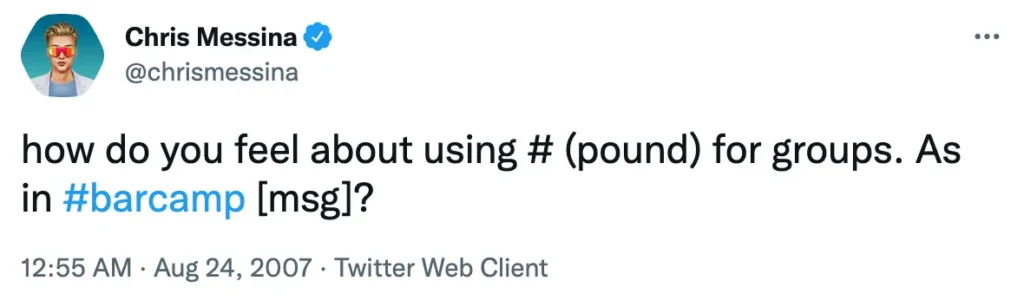
Twitter is a conversation-heavy platform and hashtags play an important role. Hashtags are extremely useful for tracking breaking news and trending topics in the Twitterverse. You can’t get away with not using them on this platform.
Twitter is also the platform where it makes sense to use hashtags at the beginning, middle, and end of a tweet. This isn’t to say you can’t do it on other platforms, but it seems to blend in better on Twitter.
Use it at the beginning to draw attention and at the end to provide context. Hashtags in the middle of tweets are useful for emphasizing keywords.
As a best practice, Twitter recommends using no more than two hashtags. More practically though, you can use about two or three hashtags for your posts. One for context and maybe two for highlighting the main keywords.
Instagram is an excellent platform for visual branding and content discovery based on local trends and hashtags. They can be used in posts, stories, comments, and even in the bio.
This platform has aided with the proliferation of hashtags into the mainstream. Instagram allows users to use up to 30 hashtags. That doesn’t mean you should overload the post with every hashtag under the sun.
This is primarily where your research comes into play. Review each relevant keyword and pick what you believe best represents your content. Rather than just using the Instagram-suggested hashtags by default, spend a little time with the tools suggested earlier in the article. This can be extremely beneficial to you.
On Instagram, it is imperative for you to use as many hashtags as make sense. The ideal number is somewhere between 6 and 17 relevant hashtags. There have been many statistical studies done on the number of hashtags on this platform. However, aiming for that statistical number should not be your goal. Try to cover all relevant bases backed by your research.
Facebook is increasingly making it difficult for brands to reach their audience organically. The changes to the algorithm mean that there is more emphasis on personal conversations. So logic dictates that hashtag usage is essential for your content to reach far and wide.
This theory fails because of the manner in which people use hashtags on this platform. Very rarely do people search for specific hashtags while scrolling through the content. Facebook also doesn’t curate content based on hashtags à la Instagram. So the question is, should you even be using hashtags on Facebook?
In an ideal world, the answer would be no. Making use of hashtags on Facebook does not serve the intended purpose. It is preferable to publish posts devoid of hashtags. The only exception to this rule is branding exercises where you would use campaign hashtags.
For creative campaigns though, using a single campaign hashtag may actually benefit you. Audiences who liked your content and want to see more will click on the campaign hashtag. They will then see your campaign content grouped together, giving your brand increased exposure.
The argument for Facebook largely holds true for LinkedIn as well, but things are changing with this platform. As LinkedIn was slow to adopt the concept of hashtags, sometimes they tend to appear a bit unprofessional even today. Owing to this, you’ll typically see a mixture varying from no hashtags to too many hashtags on LinkedIn.
While LinkedIn recommends using not more than three hashtags per post, practically three may be too many. If you were to look at the LinkedIn company page feed, they tend to use either one hashtag or none at all. This is also the approach you should take.
You need to keep testing the waters on this platform. Publish some posts with a contextual hashtag and certain posts without any. Similar to Facebook, there is a compelling case for using campaign hashtags on this platform as well.
Hashtags Increase Your Brand Awareness
When used correctly, hashtags can significantly increase brand awareness. Hopefully, the suggestions in this article will serve as a catalyst to help you get there. Once you incorporate all of these suggestions, you will be able to use hashtags to give your posts the boost they deserve.
Do you have any additional suggestions for increasing social posts’ visibility and engagement with hashtags? Please send me a note to let me know.
BONUS – Should You Use Hashtags In Paid Posts?
In short, no!
Hashtags, in general, help with increased visibility and reaching those who would not have seen your post otherwise. When you use advertisements, you are paying the platforms to do exactly that. Adding a hashtag here is not only redundant but also detrimental to the performance of the ad.
If someone clicks on that hashtag instead of the CTA, they will be directed to a search page with that hashtag. That is not the journey you want your prospective audience to take. The only exception is for campaign hashtags, and even then, only if absolutely necessary.
If you want to know more about running an effective paid campaign, I’ve created just the resource you need. Check out The Paid Social Marketing Handbook available as a free download. It will give you advice on all the things you need to get going as well as the things to take into account when running an effective paid campaign.